
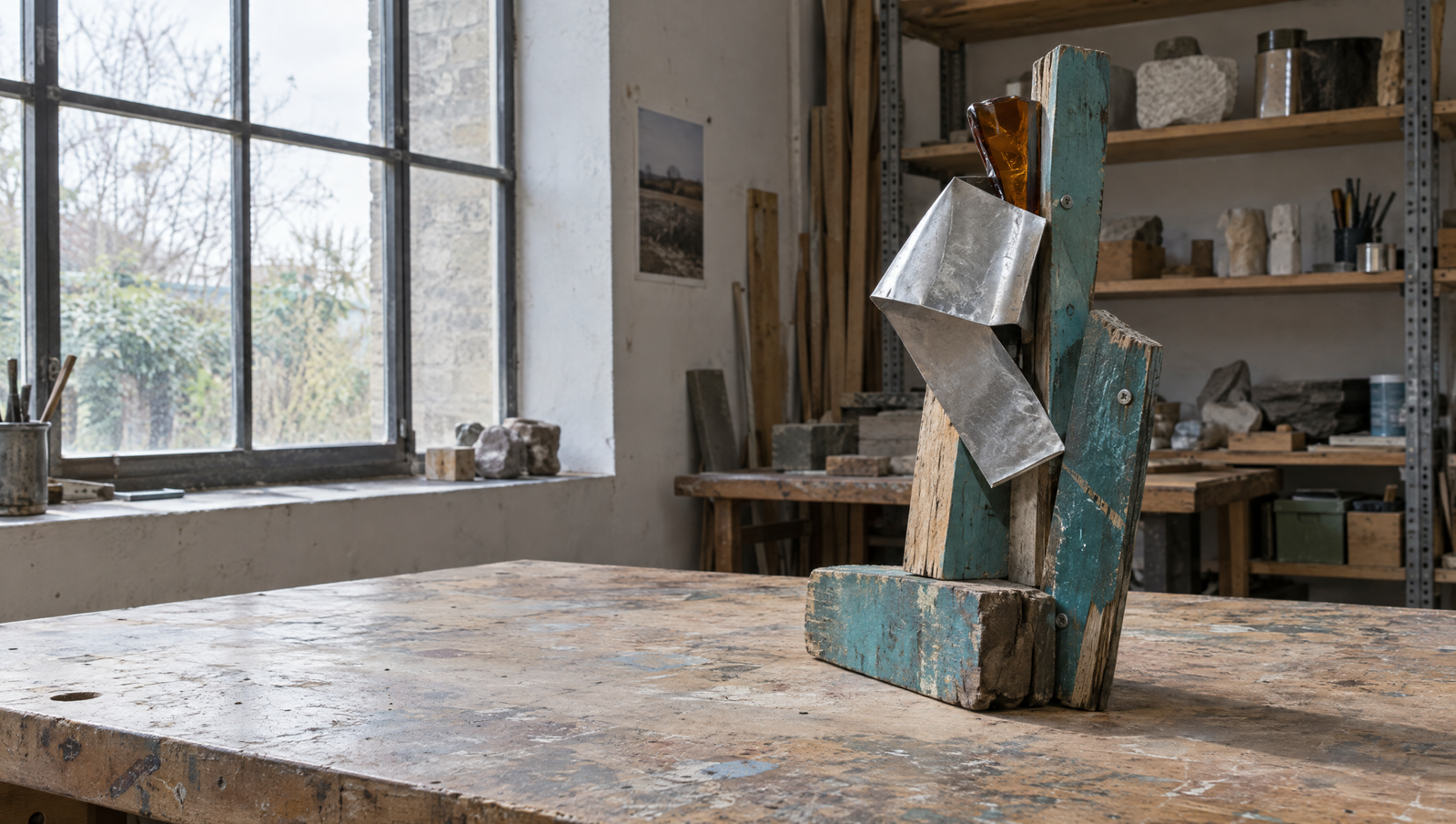
A piece of wood has an old screw hole, a patch of paint and an edge worn smooth by use. You might put it in a skip. An artist might turn it over, hold it beside another piece and keep it.
That small difference in attention is where this story begins.
Recycled materials in art can include discarded metal, packaging, clothing, timber and other objects given a new role. Artists may reuse them directly, cut and assemble them, or process them into another material. Their interest can involve texture, memory, consumption or the possibilities of a particular shape.
At Best Art Gallery, we believe an artist’s thoughts are also art. With reclaimed materials, those thoughts sometimes begin before anything is made: why keep this object? What remains of its previous life? How much of that history should a viewer be able to see?
Part 01 · A material with a past
What Counts as Recycled Material in Art?
“Recycled art” is a useful everyday phrase, but it covers different processes. A discarded door incorporated into a sculpture has been reused. Paper pulped into a new support has been processed. An artist might do both within one work.
A found object is something brought into an artistic context from elsewhere. It need not have been rubbish. A household item, a flea-market purchase or an inherited object can become part of an artwork.
Assemblage brings objects or materials together into a three-dimensional work. MoMA’s definition includes found objects and unconventional art materials. The term helps describe the making without assuming that every component has been recycled.
These distinctions make an artist’s choices easier to discuss. Instead of stopping at “made from waste,” ask what was kept, what was changed and what was added. The answer may be much more interesting than the label.
Part 02 · Looking before making
Why an Artist Might Keep What We Discard
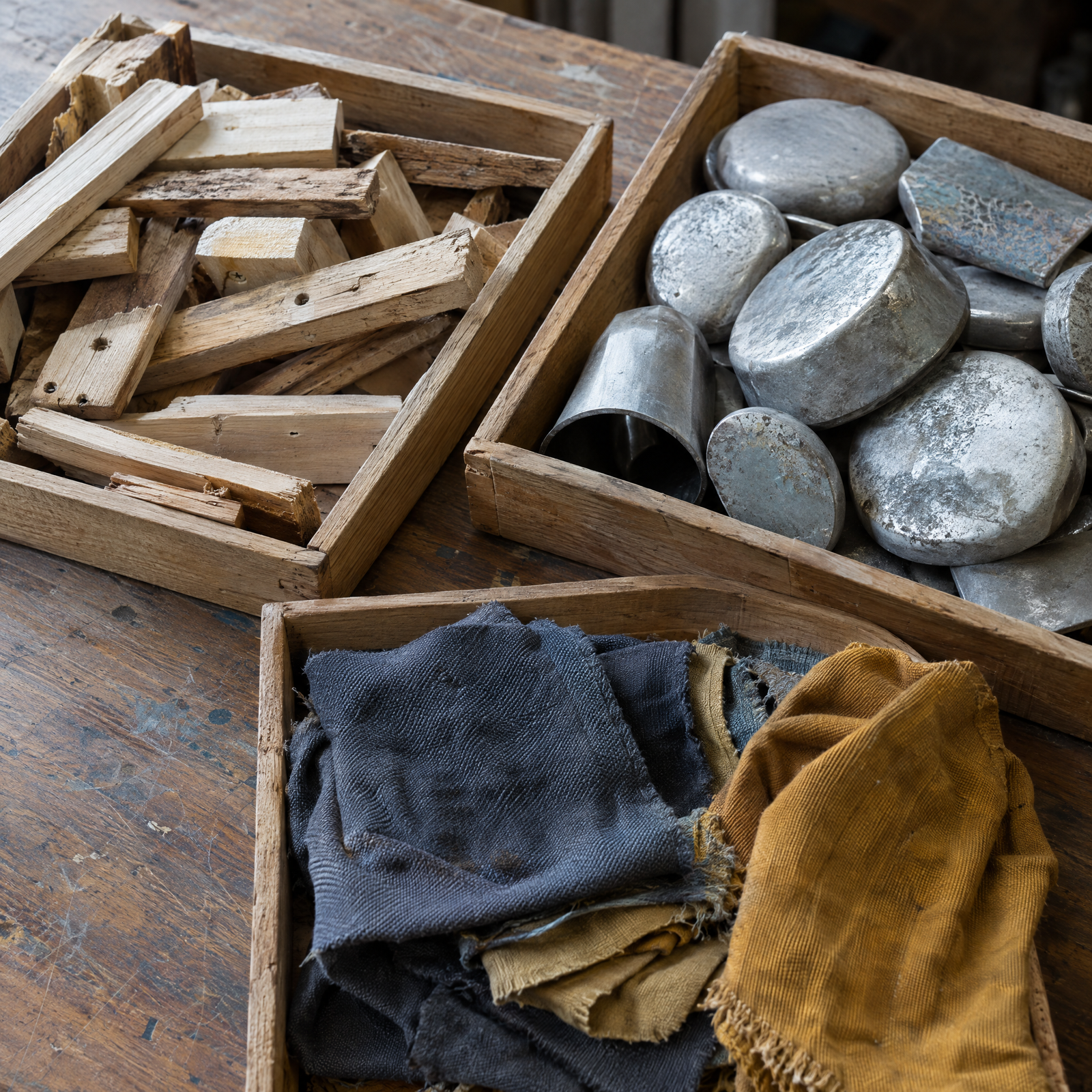
A new sheet of material offers a relatively consistent starting point. A used one arrives with differences: a crease, a stain, a broken corner or a faded area that cannot be ordered twice.
For an artist, those differences can suggest a decision. A bent piece of metal might establish a curve. The underside of a drawer might provide a shallow space. An old seam could interrupt an otherwise smooth surface.
There is also the matter of association. A piece of clothing may remind us of a body; a fragment of roofing may suggest a building. An artist can preserve that recognition, obscure it or let it appear only after a second look.
None of these meanings is automatic. A worn shirt does not tell us whose shirt it was. If the history matters to the work, look for the artist’s account rather than filling the gap with a story of our own.
Try looking at an ordinary discarded object as a collection of physical details. What does its surface do in the light? Where does it bend? What happens if it is turned sideways? You begin to see why choosing the material can already be part of the work.
Part 03 · A longer artistic history
Artists Have Been Working With Everyday Objects for Decades
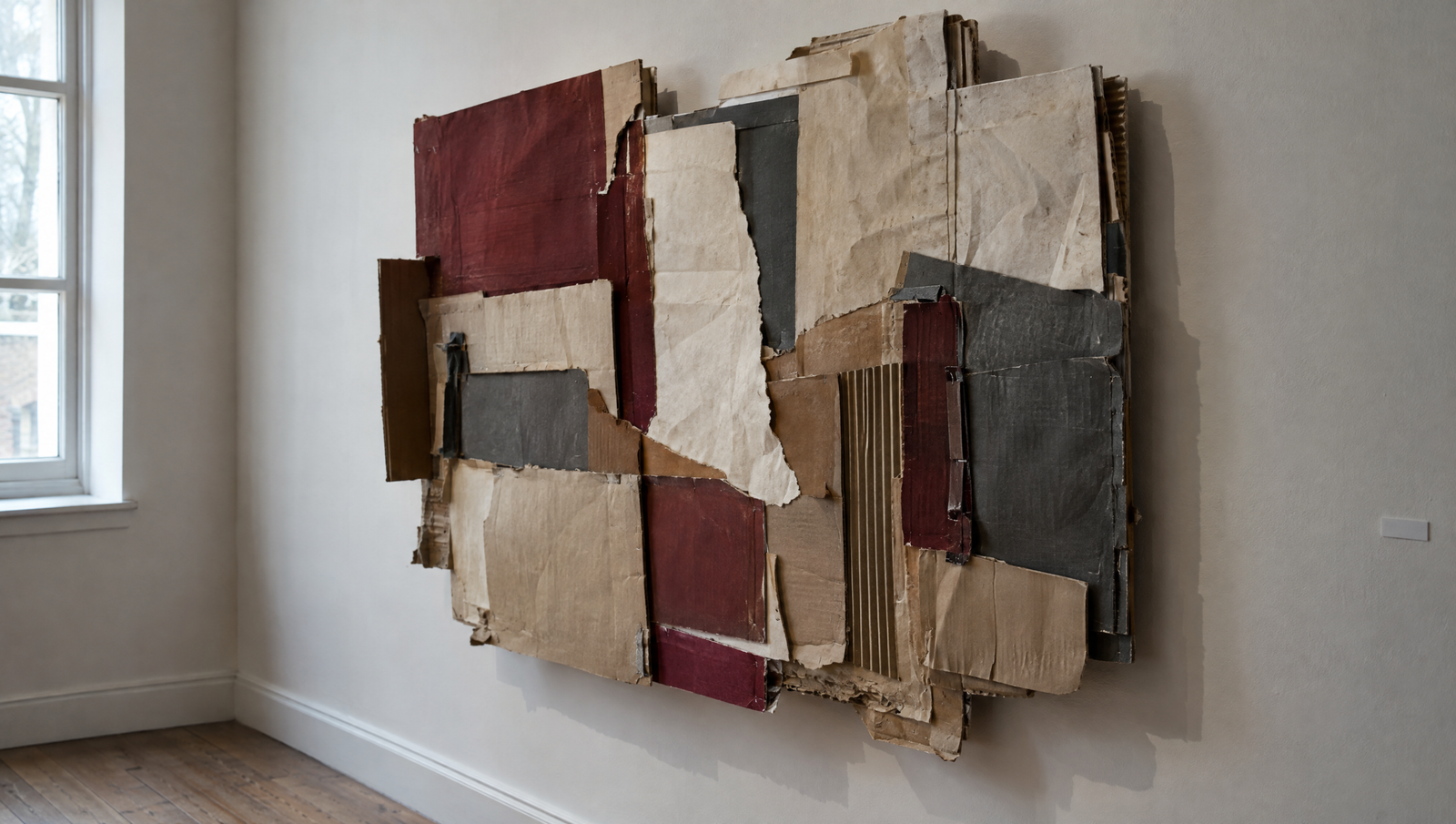
This practice has a history well beyond today’s environmental conversation. MoMA’s account of its 1961 exhibition The Art of Assemblage describes artists bringing everyday materials and objects into their work, from paper and cloth to wood and automobile parts.
The historical connection matters because reused materials can serve many purposes. An unexpected combination might create humour, disturb a familiar association or bring the ordinary world into an exhibition room.
Consider a chair fragment. Left recognisable, it may make us think about sitting or absence. Cut into smaller units, it may become a rhythm of curved forms. Painted, it may lose some of its previous identity while retaining its shape.
The source material and the finished composition both deserve attention. Knowing what an object used to be can enrich the encounter, but the arrangement still has to give us something to look at.
Part 04 · Three practices to explore
What Specific Artists Do With Discarded Materials
El Anatsui: Small Metal Pieces, a Changing Surface
El Anatsui’s Dusasa II, in The Met’s collection, offers a way to look closely at transformation. The museum describes discarded aluminium liquor-bottle caps and seals flattened, shaped and joined with copper wire.
Individual units become part of a flexible, expansive surface. Seen together, they can suggest cloth; close attention brings the separate metal elements back into view.
The Met also connects the material with consumption and consumerism. That gives us more to consider than the fact of reuse. The components have a role within a particular artistic and historical account.
Follow the museum link to see the actual work. Move between a full view and a detail. What changes when you recognise the small units from which the larger surface is made?
Catriona Robertson: Newspaper Pulp and an Imagined Ecology
For a current example, Catriona Robertson’s WYRM is presented at Frieze Sculpture 2026. Her practice uses discarded urban materials and papercrete, a combination of concrete and recycled newspaper pulp.
The installation imagines large worm-like forms moving through the earth: organisms adapted to metabolise industrial waste. This is a speculative artistic idea, rather than a description of an existing biological solution.
What interests us is the connection between the material and the imagined world. Debris from the city becomes part of a work asking what future environments might grow from what we leave behind.
Douglas White: Recognising a Material Twice
Also at Frieze Sculpture, Douglas White’s Black Palm uses discarded tyres to create a palm-like form.
That change invites two kinds of recognition. We may first register the silhouette of a tree, then notice the rubber and its industrial associations. The second recognition changes the first.
Frieze Sculpture runs in London’s Regent’s Park from 16 September to 1 November 2026 and is free to visit. These examples have different ambitions; the shared use of discarded material does not make their meanings interchangeable.
Part 05 · The decisions in the detail
Look at the Join, the Edge and What Remains Visible
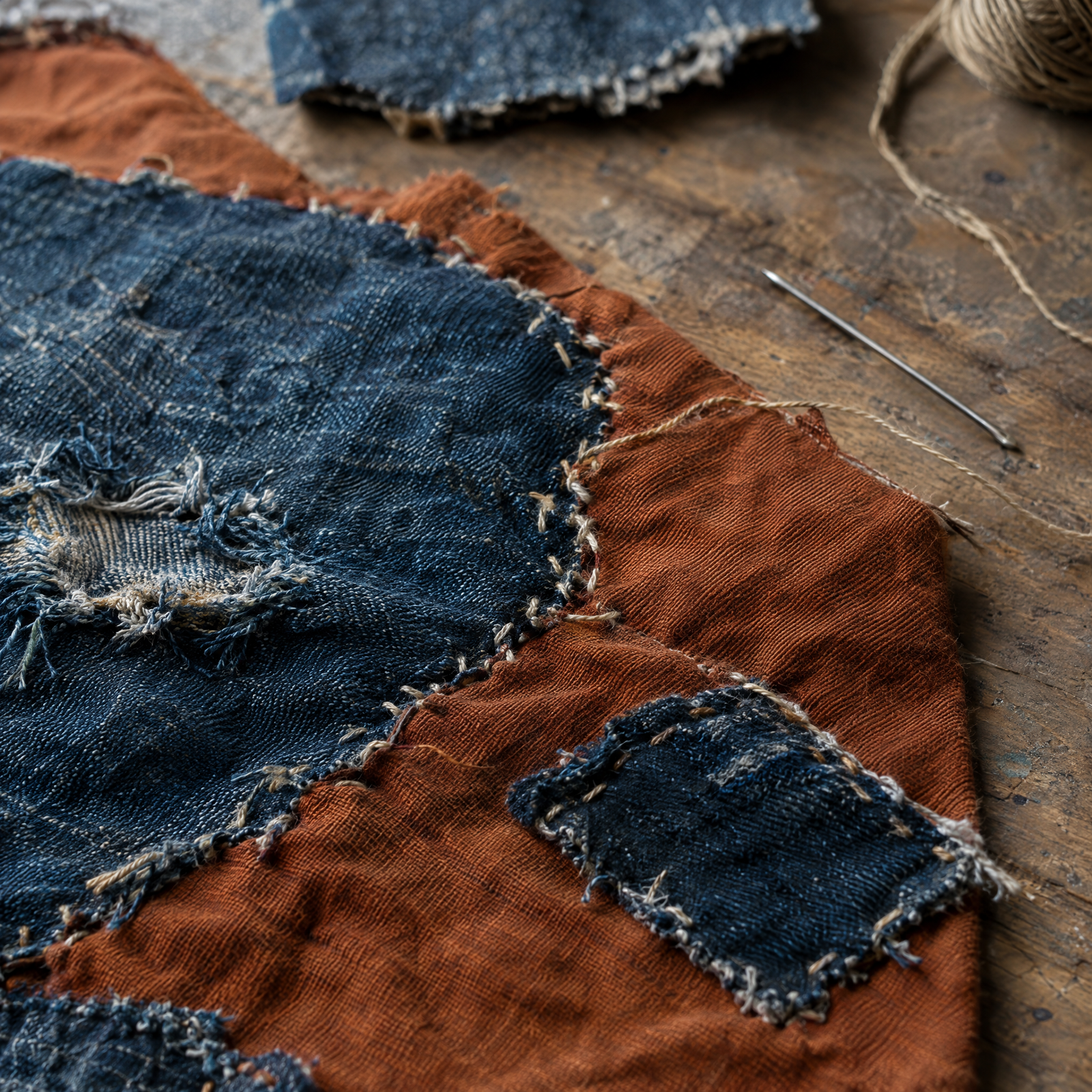
A join can tell you how an artist wants separate parts to meet. Wire may leave movement between components. Stitching can hold a torn edge while allowing the tear to remain visible. A rigid connection can make fragments behave as one form.
Ask what the artist has chosen to preserve. Is old paint still present? Have labels been removed? Does the work invite you to recognise the previous object, or is that information available only in the description?
Scale changes the experience too. A familiar small object repeated across a large surface may become difficult to recognise at first. A single fragment placed on its own can draw attention to details that would disappear in a pile.
Useful questions are simple: why this material, why this arrangement, and what would change if the artist used something new? There may be several answers. The question brings the conversation back to the actual work.
Best Art Gallery · Editorial perspective
Part 06 · Asking about environmental claims
Does Reusing Material Make an Artwork Sustainable?
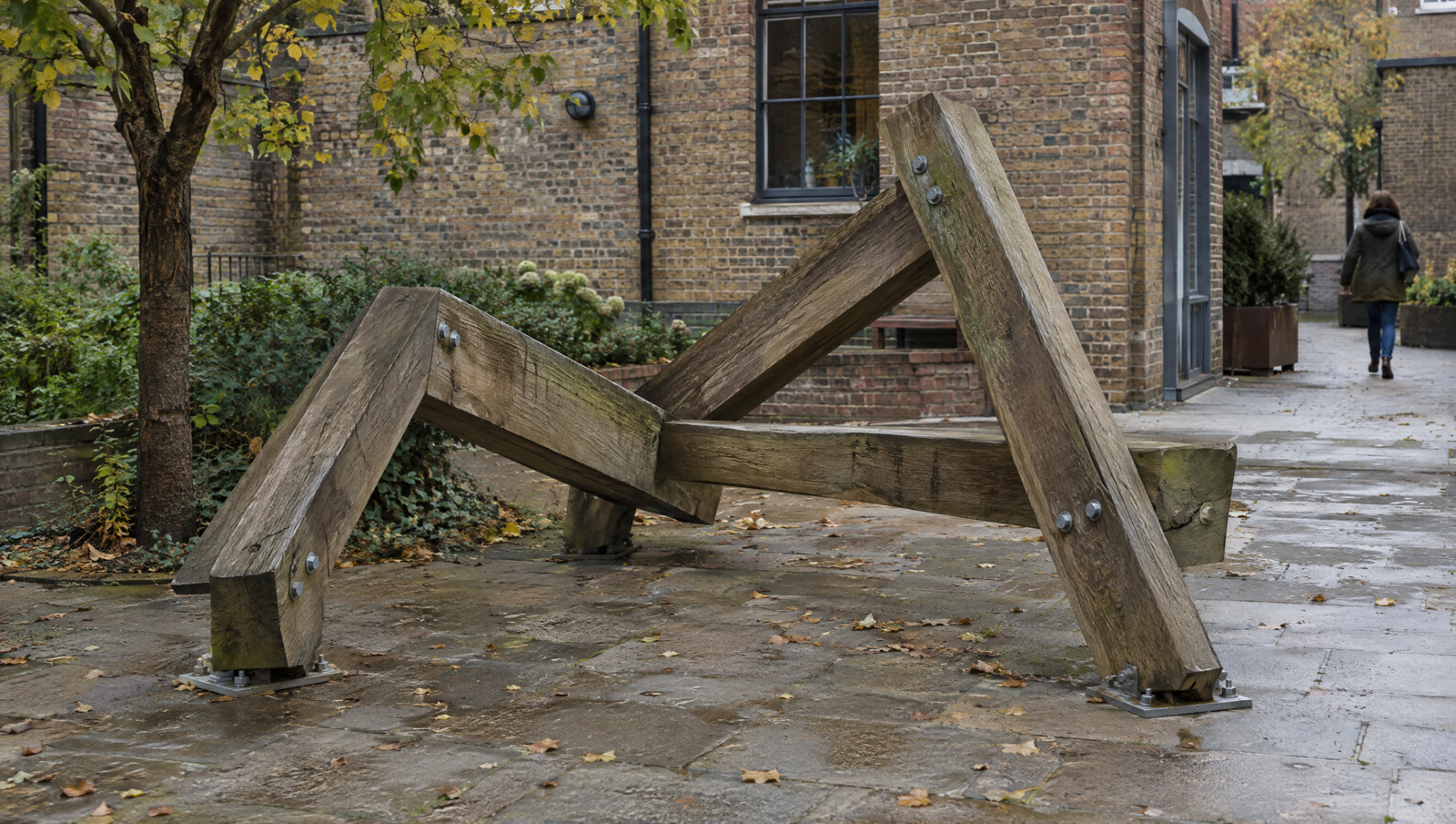
Reuse is one part of the process. On its own, it does not establish the environmental impact of a whole artwork.
Other questions remain: what new materials were added, how much processing was involved, how the work was transported and what happens when it needs repair or is taken apart. A sculpture can address waste without every part of its production being low impact.
We should be specific in a gallery description. “Made with reclaimed timber” tells a reader something concrete. “Completely sustainable” needs much more evidence.
The artistic question and the environmental question can sit together. A work may prompt an important conversation about consumption, while leaving practical production questions open. Asking those questions gives the subject more depth.
If you are researching a piece, request a material list and an account of how the reclaimed elements were sourced. Distinguish documented facts from the interpretation offered around them.
Part 07 · Living with a material history
What Collectors Should Ask Before Bringing the Work Home
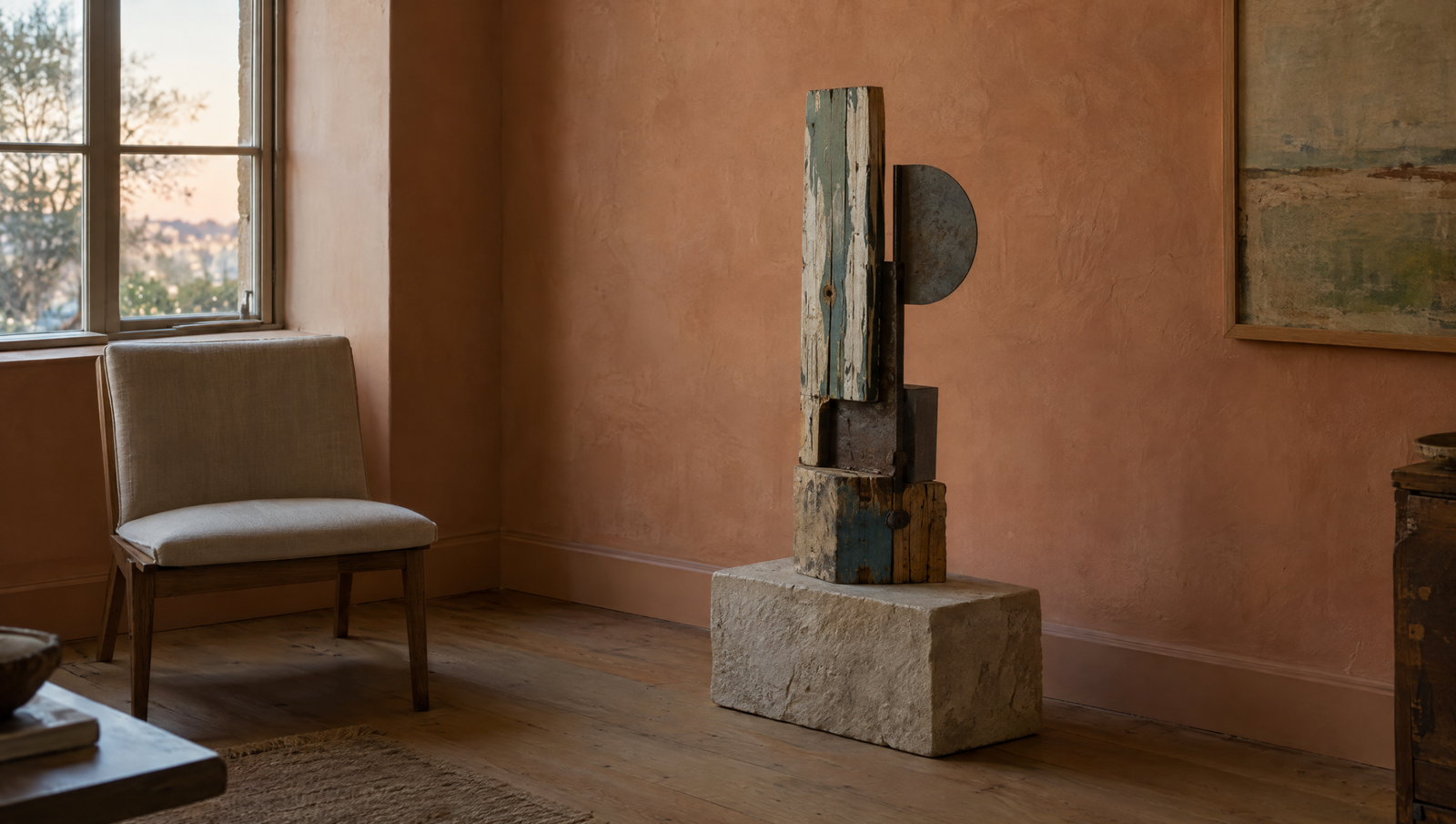
Begin by asking what the work is made from and which changes are intentional. A rusted surface or faded cloth may be part of the artist’s decision. Knowing that helps distinguish the intended appearance from later deterioration.
Request care and installation guidance specific to the piece. Ask which parts can be handled, how it is supported and whether anything is expected to move, settle or change over time. For a complex work, the gallery or a suitable conservator can help clarify those requirements.
Keep the material description, condition photographs and installation instructions with your records. Avoid cleaning, polishing or replacing a component simply because it looks worn; first establish its role in the work.
Our first original artwork guide covers the broader questions around purchasing and documentation. With reclaimed materials, add one more: what part of the object’s previous life am I now responsible for preserving?
At Best Art, that question is part of why these practices deserve a closer introduction. A bottle seal, a timber offcut or a piece of cloth can carry us into an artist’s way of seeing. The material has been kept, but it has also been reconsidered.
Next time an unfamiliar object appears in an artwork, spend a moment with the choice. What has the artist noticed—and what does the new arrangement allow you to notice?
Explore how individual artists develop ideas through materials, process and the things they choose to keep.
Frequently Asked Questions
What are recycled materials in art?
They are previously used or discarded materials given a new artistic role. Examples include paper, packaging, metal, clothing and wood. Artists may reuse objects directly or process them into a different material.
What is the difference between assemblage and recycled art?
Assemblage describes a three-dimensional work made by combining objects or materials. “Recycled art” describes the reuse or transformation of previously used material. A work can fit both descriptions, but assemblage does not always involve discarded objects.
Which artists work with discarded materials?
Examples include El Anatsui, who joins discarded bottle caps and seals into large surfaces; Catriona Robertson, whose practice includes recycled newspaper pulp; and Douglas White, whose Black Palm uses discarded tyres. Their individual intentions differ.
Is art made with recycled materials always sustainable?
No. Reuse is one factor. Added materials, processing, transport, repair and eventual disposal also matter. Ask what a sustainability claim refers to and what evidence supports it.
How should I care for an artwork made from reclaimed objects?
Follow instructions specific to the work. Establish which worn surfaces are intentional, keep condition records and ask before cleaning or replacing anything. Installation and handling may require guidance from the artist, gallery or conservator.
Recycled Materials
Assemblage
Contemporary Sculpture
Artist Practice
Images are AI-generated editorial illustrations of invented artworks and fictional settings. They do not depict works by El Anatsui, Catriona Robertson or Douglas White, or actual Frieze installations. Follow the source links to see the named artworks. Exhibition information checked on 14 October 2026.
