

Contemporary editorial illustration; not Lee Krasner or her studio. Follow the museum links in this article to see her actual work.
Read about Lee Krasner for a few minutes and Jackson Pollock’s name soon appears. Their relationship matters. But what happens when you know more about her marriage than about a single painting she made?
That question is why we wanted to spend time with her work.
At Best Art Gallery, we believe an artist’s thoughts are also art. Writing about an artist means paying attention to how those thoughts take shape: a mark repeated, a composition reconsidered, an old drawing given another life. Krasner’s career offers all three.
She also leaves us with a question closer to home. When we introduce an artist, what do we help someone see—and what do we leave out?
Part 01 · Why this story now
Two Artists, With Room for Each
The Met’s Krasner and Pollock: Past Continuous, running from 4 October 2026 to 31 January 2027, brings together more than 120 works across both careers. Its subtitle comes from a 1976 painting by Krasner.
The museum describes their practices as distinct and deeply connected. That is a useful place to begin. Artists share influences, argue about work, encourage each other and sometimes change direction through a conversation. A relationship can be part of the making.
Still, a shared life contains two people making decisions. Giving Krasner more attention means looking closely enough to recognise hers.
If you visit, choose one of her works before reading the full story on the wall. Notice what holds your attention. Then read the label and return to the painting. Does the information help you see something new, or does it pull your attention away from the surface?
That small change in order can make a difference.
Part 02 · Before the marriage
Krasner Was Already Building a Life in Art
Krasner was born in Brooklyn in 1908. She studied at Cooper Union and the National Academy of Design, and began working with Hans Hofmann in 1937. By the time her relationship with Pollock began in late 1941, she had joined the American Abstract Artists and was developing her own approach to abstraction.
Those details, documented by the Pollock-Krasner House and Study Center, give the story a different starting point. Here is an artist choosing schools, finding peers and questioning what she had learned.
That last part interests us. An artistic education can provide skills while leaving a painter dissatisfied with how to use them. Returning to study, as Krasner did, takes effort and a willingness to admit that the work needs something more.
Begin her story there and the marriage enters an existing career. The reader has already met someone with ambitions and a working life.
Part 03 · One painting to begin with
Spend a Few Minutes With a Little Image
If Krasner is new to you, start with MoMA’s record of Untitled, 1949, from her Little Images series. You can look at the actual painting through that link.
MoMA describes thick paint applied in repeated strokes, arranged within a grid-like structure. The marks suggest symbols, but there is no message for us to translate. Krasner was interested in a private visual language.
Try following a row of marks. Then let your eye move elsewhere. Repetition offers a way through the surface, but small differences keep catching your attention. What seemed like an overall pattern begins to feel less uniform.
You can stay with that experience without finding a hidden meaning. How the paint sits, how the marks gather and where your eye pauses are already worth noticing.
For a gallery, this is where a description earns its place beside a work. It should help a reader notice something specific. “Expressive” might be true, but a sentence about the placement of a mark gives us more to look at.
Part 04 · The work returns
What Would You Do With an Old Drawing?
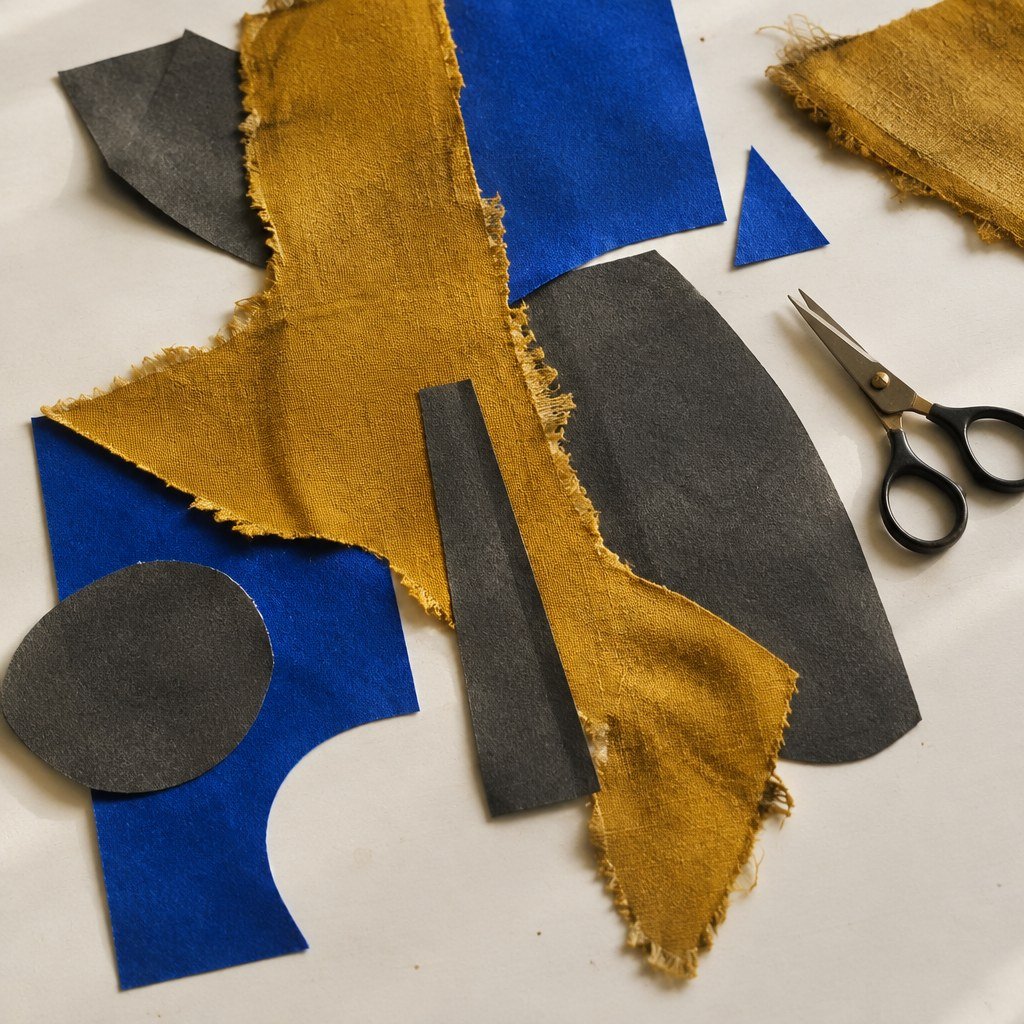
Imagine finding a drawing you made years ago. You might keep it as a record, put it back in a folder or decide it no longer represents you. Krasner found another possibility: earlier work could become material for a new composition.
The Barbican’s Living Colour exhibition in 2019 brought her collages made from earlier work into a wider account of her career, alongside the Little Images and large paintings.
A fragment carries something with it. Part of a line survives. An edge ends abruptly. Place it beside another piece and the relationship changes. Collage makes those decisions visible in a way a seamless painted surface may not.
For artists who worry that changing direction means losing their identity, there is something encouraging here. A practice can remain recognisable through the questions an artist keeps asking, even when the answers look different.
In 1976, Krasner used drawings from her Hofmann student years in a new collage series. Nearly forty years separated the making of those drawings from their reuse.
Think about that interval. The artist returning to the paper had decades of work behind her. The drawing could now do something its younger maker had never planned.
That is the part of this story we would want an artist to take away: an earlier attempt does not have to remain an earlier attempt. Sometimes you need time before you can see what else it offers.
Part 05 · Letting a painting occupy space
A Screen Cannot Tell You Everything
Move from the Little Images to The Seasons, 1957, in the Whitney’s collection, and scale becomes part of the conversation.
On a phone, a large horizontal canvas and a smaller work can appear almost the same size. The reproduction allows us to study the composition, but it makes the physical encounter harder to imagine.
When you can see a painting in person, give yourself room to move. Stand back, then come closer while respecting the gallery’s viewing distance. Ask what becomes clear from one position and disappears from another. The whole painting and a small passage of paint ask for different kinds of attention.
Krasner’s life included painful losses. Those circumstances belong in her history. Yet we should hesitate before attaching a personal event to every gesture in a painting. A brushstroke also involves pressure, direction, colour and its place beside another brushstroke.
We want to leave enough room for all of that.
Best Art Gallery · Editorial perspective
Part 06 · Looking back carefully
What Gets Lost in the Word “Rediscovered”?
“Rediscovered” is an appealing word. It promises that something valuable has finally received attention. Before using it, though, we need to ask who was looking before us.
Krasner had a solo exhibition at London’s Whitechapel Gallery in 1965. The Whitney’s Lee Krasner: Large Paintings followed in 1973–1974. These were significant exhibitions during her lifetime.
They do not mean that her reputation received equal attention to Pollock’s. They do mean that a story beginning with “nobody knew her work” would leave out important parts of the record.
The more interesting question is how recognition and a limiting description can exist together. An artist can have exhibitions, collectors and critical attention while still being introduced through someone else’s name.
For us, this is a reminder to look at the choices within a feature. Which work comes first? How much space goes to the artist’s process? Does the headline open a door into the practice, or settle the reader’s impression before they have seen anything?
A fuller account is built through those choices. Even the first paragraph has a job to do.
Part 07 · Bringing the question home
How We Want to Introduce an Artist
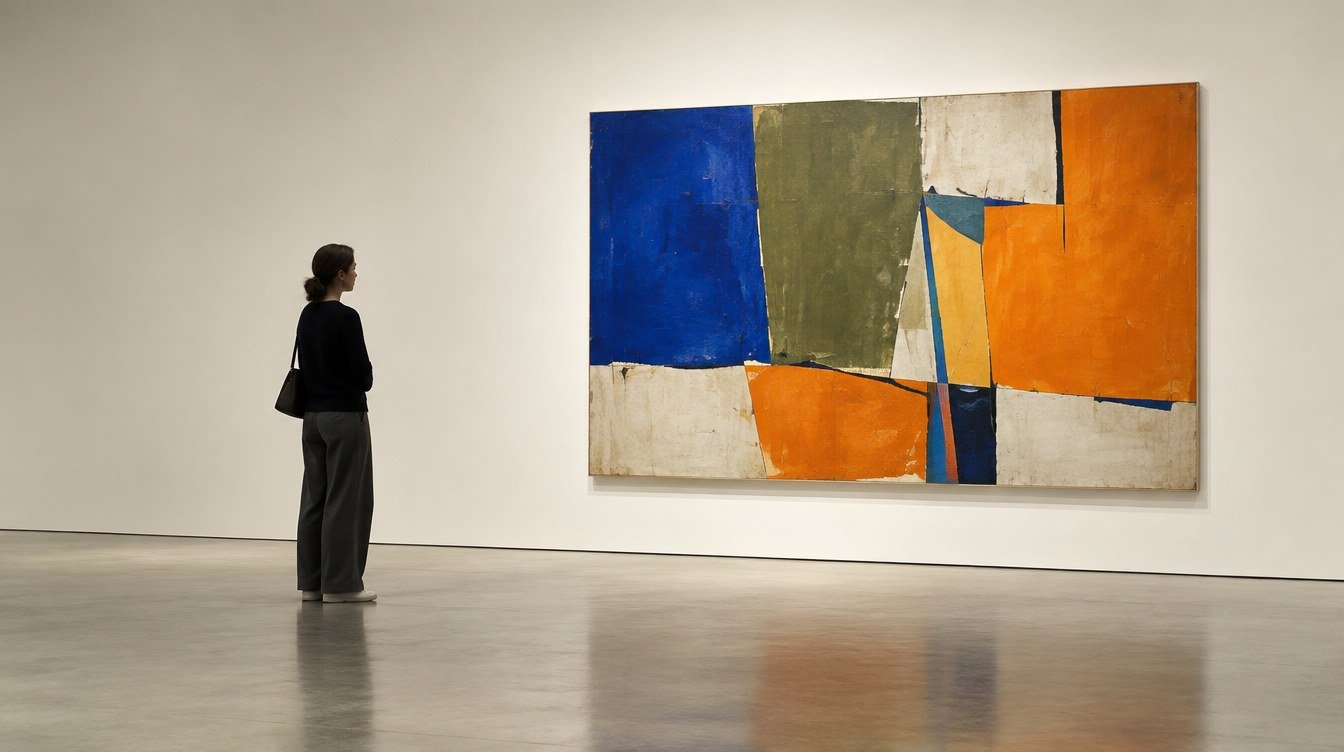
Krasner’s story makes us think about the responsibility of a gallery’s voice. Readers often meet an artist through a short introduction. That introduction can influence what they notice next.
At Best Art, we want to make space for the decisions behind the work. Why this material? What keeps the artist returning to an idea? What changed between one series and the next? These questions let a particular person emerge.
When writing about women artists, we need the same curiosity and specificity. Gender can be important to an artist’s experience. It does not tell us what her paintings will look like, what she wants from them or how she will develop.
For collectors, there is a practical question here too. When a gallery tells you an artist’s story, does it help you understand the artwork you are considering? Ask to see another piece from the series. Ask about the materials. Compare the description with what you can observe.
And if you have never spent time with Krasner, begin with one painting. You do not need to remember the whole chronology. Look long enough to form a question of your own. Her work gives you plenty of places to start.
Meet the artists featured at Best Art Gallery, and spend time with the ideas and working lives behind their art.
Frequently Asked Questions
Who was Lee Krasner?
Lee Krasner (1908–1984) was an American artist associated with Abstract Expressionism. Her practice included painting, drawing and collage, with significant changes in scale, composition and materials across her career.
What are Krasner’s Little Images?
They are a series of paintings from the late 1940s that use repeated marks and closely organised surfaces. MoMA’s Untitled, 1949 offers an example of a grid-like structure and symbols that suggest a private visual language.
Why is collage important to her practice?
Collage allowed Krasner to cut and rearrange existing material into new compositions. Her later reuse of earlier drawings demonstrates how an artist can return to previous work and give it a different role.
Was Krasner recognised during her lifetime?
Yes. Her lifetime exhibitions included a Whitechapel Gallery solo presentation in 1965 and the Whitney’s Large Paintings exhibition in 1973–1974. These achievements belong in an account that also examines how her work was framed.
When is the Met’s Krasner and Pollock exhibition?
Krasner and Pollock: Past Continuous runs from 4 October 2026 to 31 January 2027 at The Met Fifth Avenue in New York. Check the museum’s official exhibition page for current visitor information.
Lee Krasner
Women Artists
Abstract Expressionism
Art History
Images are AI-generated editorial illustrations of contemporary people, invented artworks and fictional settings. They do not depict Lee Krasner, Jackson Pollock, their artworks or the named exhibitions. Exhibition information checked on 7 October 2026.
