14
June
Painting Is Dancing With the Hands — The Emotional Portraits of Pilarcho Yanguas
Why art galleries matter in 2026
- 23 May
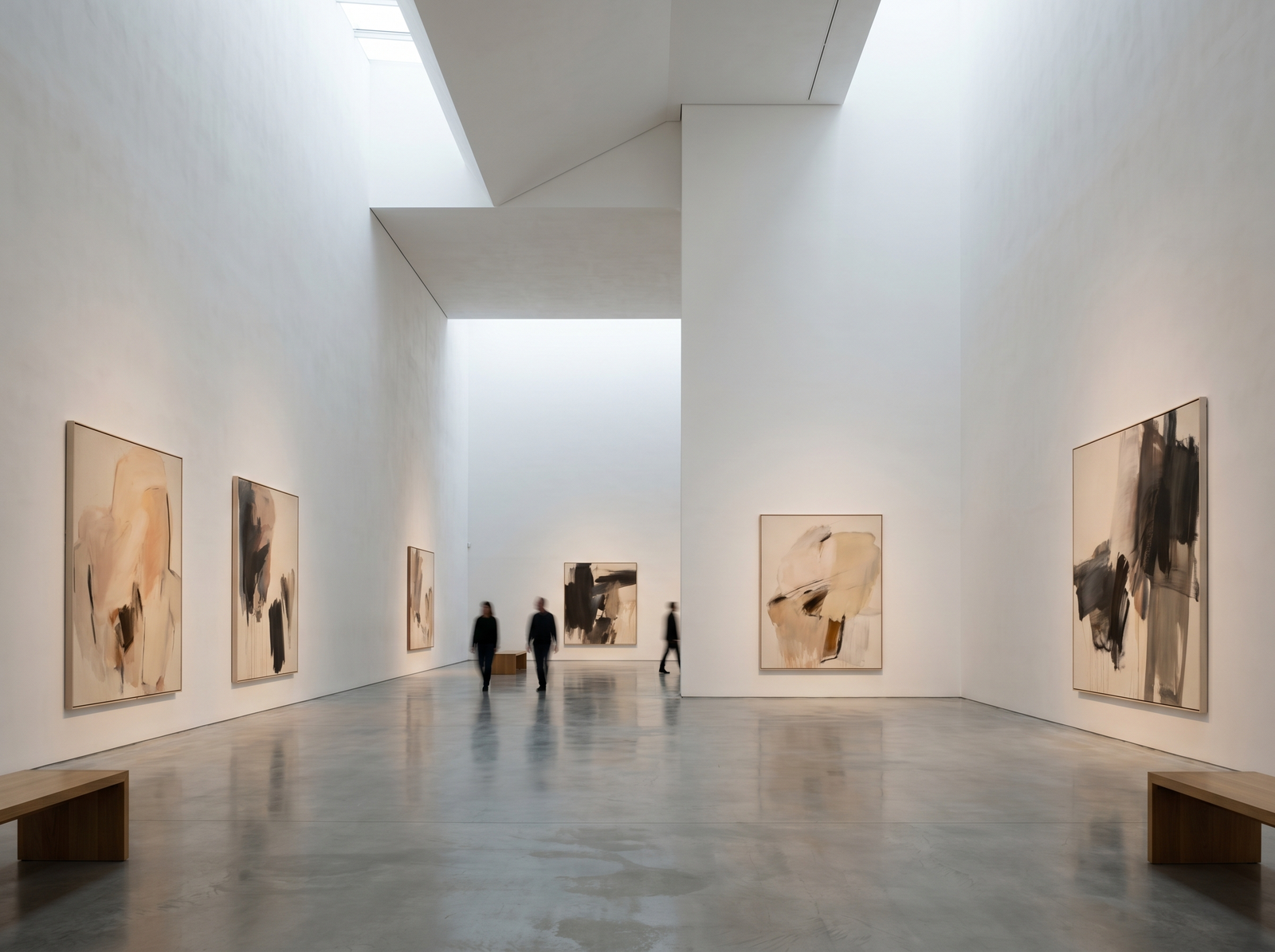
The gallery floor — still the most important room in the art world.
Understanding why art galleries matter in 2026 requires looking honestly at a global art market that is — cautiously, tentatively — turning a corner. After three years of contraction, a wave of gallery closures, and a Giacometti that flopped at auction for USD 70 million, the market ended 2025 with clear signs of life: USD 2.2 billion sold in the November marquee auctions in New York, successful fairs in London, Paris, and Miami, and a new generation of collectors rewriting the rules of who buys art and why.
In this transformed landscape, the physical art gallery is not a relic. It is the answer. From the rise of experience-led collecting to digital art finding its permanent seat at the table, from the Middle East emerging as the market's most watched frontier to private sales reshaping how major works change hands — every major trend of 2026 points back to the same irreplaceable institution. Here is why.
1. Galleries Are Where Experience Replaces Transaction

The trusted relationship between gallery and collector — irreplaceable.
The most discussed shift in the luxury and collecting world is the move from acquiring objects to seeking experiences. Research from Bain points to what some are calling a tectonic shift in the luxury market — buyers increasingly choosing experiences over possessions. Global spending on luxury hospitality alone is projected to exceed USD 390 billion by 2028, up from USD 239 billion in 2023.
For the art world, this is not a threat to galleries — it is their great opportunity. A gallery visit is not a transaction. It is an encounter: with an artist's mind, with a curator's argument, with other collectors and thinkers in a room charged with possibility. Online platforms can deliver images at speed and efficiency. They cannot deliver the silence in front of a large canvas, or the conversation with a dealer who has spent thirty years understanding why a particular body of work matters.
In 2026, that depth of experience is precisely what collectors are paying premiums to access — and galleries provide it every single day.
2. Galleries Champion Artists That Markets Miss

Gallery openings remain the art world's most vital social and cultural moments.
One of the most important data points emerging from the 2025–2026 market is this: the lower end — works priced below USD 50,000 — is outperforming everything above it. While overall market value fell in 2024, transaction volumes actually rose. Works in the accessible price range achieved hammer prices averaging 157% of their estimated values in the New York auctions. The new collector is younger, more eclectic in taste, and more values-driven than any previous generation.
This is the territory galleries have always owned. Leading gallery voices have identified 2026's dominant currents — Floral Pop, eco-conscious art, new materiality, symbolism and cultural play — as movements being driven not by auction houses chasing trophies, but by galleries patiently building careers. None of that happens without galleries willing to take a long view on artistic development.
"Digital art is no longer at the margins — it is integral to how art and the market are evolving in real time."
— Noah Horowitz, CEO, Art Basel
3. Galleries Bridge the Digital Art Revolution

Digital art needs the gallery's curatorial credibility to become truly collectible.
At Art Basel Miami Beach in December 2025, a new section dedicated to digital and new media art sold out within five hours. Digital art now ranks third — after painting and sculpture — in total spending among high-net-worth collectors, with more than half having purchased a digital artwork in 2024 or 2025. This is a seismic shift that once seemed impossible, and it happened because galleries made it happen.
Online marketplaces can list NFTs and digital prints. They cannot provide the context, provenance, and curatorial credibility that transforms a digital file into a collectible artwork. When a gallery presents a new media artist alongside painters and sculptors it has championed for years, it makes a statement about value and longevity that no platform algorithm can replicate.
As digital art expands across Art Basel's global editions in 2026, the galleries that move decisively into this space will define what digital collecting means for the next decade.
4. The Six Reasons Why Art Galleries Matter in 2026
Based on the major market shifts documented by Art Basel, Agora Gallery, and Artsy, these are the reasons galleries remain central — not the ones that sound most impressive, but the ones that actually determine how art culture survives and grows.
Reason 01
Experience That Cannot Be Replicated Online
The physical encounter with art — silence, scale, material presence — remains the single experience no digital platform can deliver. Galleries are where that encounter happens, and demand for it is growing in direct proportion to screen fatigue.
Reason 02
Artist Development at the Accessible Price Point
The market segment growing fastest in 2026 is sub-USD 50,000. Galleries have always operated here, building careers and connecting emerging artists with collectors who are buying on conviction, not speculation.
Reason 03
Curatorial Legitimacy for Digital and New Media Art
Digital art needs gallery context to become collectible rather than merely purchasable. Galleries are the bridge between new media creativity and serious, long-term collecting.
Reason 04
First Movers in Every New Art Market
The Gulf, Southeast Asia, Latin America — wherever a new art market is forming, galleries do the foundational work. They bring artists, build collector relationships, and establish the trust networks that make regional scenes durable rather than speculative.
Reason 05
The Private Sale Model — Which Is the Gallery Model
Private sales now account for 20% of all auction house revenue, up from 12% a decade ago — because the gallery's way of working, built on trust and discretion, is what the market wants. The art world is catching up to what galleries have always done best.
Reason 06
Cultural Sustainability That Markets Cannot Manufacture
Galleries champion the eco-conscious, identity-driven, and materially honest work that defines 2026's most meaningful art movements. That commitment to values over trends is what makes a gallery culture — not just a market.
5. Galleries Are Opening the World's New Art Frontiers

All eyes in the art world are on the Gulf in 2026 — and galleries are doing the foundational work.
Art Basel launches a new fair in Qatar in 2026. Frieze debuts in Abu Dhabi. Abu Dhabi's ADQ made a USD 1 billion investment in Sotheby's in 2024. Qatar's cultural footprint continues to expand with a new quadrennial launching later this year. This is not a footnote — it is a frontier, and galleries are the first movers building it.
The same pattern repeats across every new art market in history. Wherever culture begins to form around collecting, galleries are there first — educating buyers, introducing artists, creating the vocabulary and the relationships that make a scene durable. As Art Basel's analysis of 2026 trends makes clear, the road to establishing new market hubs is long — and galleries are the ones willing to walk it.
6. The Conversation the Art World Still Needs to Have

The quiet encounter between viewer and artwork — irreplaceable, timeless, essential.
There is a version of this conversation that focuses entirely on the market: sales figures, auction results, fair revenues, private equity deals. That version is accurate but incomplete. Art galleries matter in 2026 not only because the market is growing around them, but because they are civic institutions. They are where communities gather around ideas, where arguments about beauty and meaning happen in public, where artists find validation and collectors find purpose beyond accumulation.
In an age of digital overload and infinite scroll, there is a growing hunger for the antidote: slowness, presence, and physical reality. The art world's own data reflects this. The renewed interest in materiality, in tactile and handmade objects, in work grounded in genuine perspective and lived experience — these are cultural responses to screen saturation. And galleries are where that response finds its fullest expression.
That is what makes a gallery irreplaceable. Not that it has always existed — but that what it does is more necessary now than it has ever been.
Key Takeaways: Why Art Galleries Matter in 2026
- Galleries offer the lived encounter with art that no digital platform can replicate — and demand for that experience is growing
- The fastest-growing segment of the art market (sub-USD 50,000) is where galleries have always operated and built careers
- Digital art needs gallery curatorial credibility to move from purchasable to truly collectible
- Every new art market frontier — the Gulf, Southeast Asia, Latin America — is being built by galleries first
- The surge in private sales validates the gallery model of trust and discretion that has always defined the best dealer relationships
- Galleries champion the values-driven, sustainable, and identity-honest art that defines 2026's most significant creative movements
At Best Art Gallery, we believe in the gallery's role at every level — for artists finding their footing, and collectors finding their voice. If you're navigating the 2026 art market — whether through private collecting, artist representation, or simply understanding what to look for — we're here for the conversation.